Submitting to UK Literary Agents: A Seasonal Timeline for Debut Novelists
A month-by-month guide to when UK literary agents are busiest, how long replies take, and how to plan your...


You have typed “The End”. Now the temptation is to start at page one and tidy the commas. Resist it. Polishing sentences in a manuscript whose third act doesn’t hold together is like cleaning the windows of a house with no roof. Editing works in layers, and every layer asks a different question of the book.
The five passes below move from the largest problems to the smallest. Do them in order, and leave time between them. A few days apart will sharpen your eye far more than any style guide.
Read the whole draft quickly, in two or three sittings if you can. You are not allowed to change a single word. Keep a notebook open and record what you notice: a subplot that fizzles out, a character who disappears after chapter eight, a reveal that lands too early to matter.
A reverse outline does most of the work here. For each scene, write one line — who wants what, what gets in the way, what has changed by the last page of the scene. If you cannot say what changed, the scene is either doing nothing or doing something twice. Merge it with a neighbour, cut it, or give it a job.
Ask the big questions now, while you are still willing to answer them. Does your protagonist want something concrete enough to fail at? Does the pressure increase, or merely repeat? Does the ending answer the question the opening posed? Fixing these things later means rewriting scenes you have already polished, which is the most demoralising work in writing.
Now go scene by scene. Most scenes have a shape: a goal, an obstacle, an outcome — and the outcome should leave things worse or more complicated than before. If a scene ends exactly where it began, it is furniture. Move it.
Look hard at where scenes start and stop. Beginners enter too early and leave too late. Try an experiment: delete the first paragraph and the last paragraph of a scene and read it again. Nine times out of ten it is tighter, and the information you thought you needed is already implied.
Characters need contradiction. A woman who wants to be promoted and also wants her colleagues to like her will generate plot without any help from you. Dialogue is the quickest test of whether your people are distinct: cover the speech tags and read a page. If you cannot tell who is speaking, the voices need work — give one character a shorter fuse, another a habit of answering questions with questions.
This pass is about the reading experience rather than the story. Look at the shape of the page. Long, even paragraphs feel like a lecture; a single-sentence paragraph lands like a punch. Vary them deliberately, especially in action scenes.
Exposition is the usual offender. When you notice a paragraph explaining the history of a city or the rules of a magic system, ask whether the reader needs it here, or merely eventually. Information delivered in the middle of a conflict sticks; information delivered while two characters drink tea slides off.
Cut the throat-clearing too — the “she walked across the room and then she opened the door” writing that reports movement without meaning. Let characters do things while they talk. Pacing is rarely about speed; it is about whether each paragraph earns its place.
Only now do you touch the sentences. Read slowly, one paragraph at a time, and hunt for habits rather than mistakes. Most drafts carry a handful of tics that weaken every page, and they are usually invisible until you go looking.
Work in small sessions. Line editing for four hours produces mush; forty focused minutes produces pages you can trust.
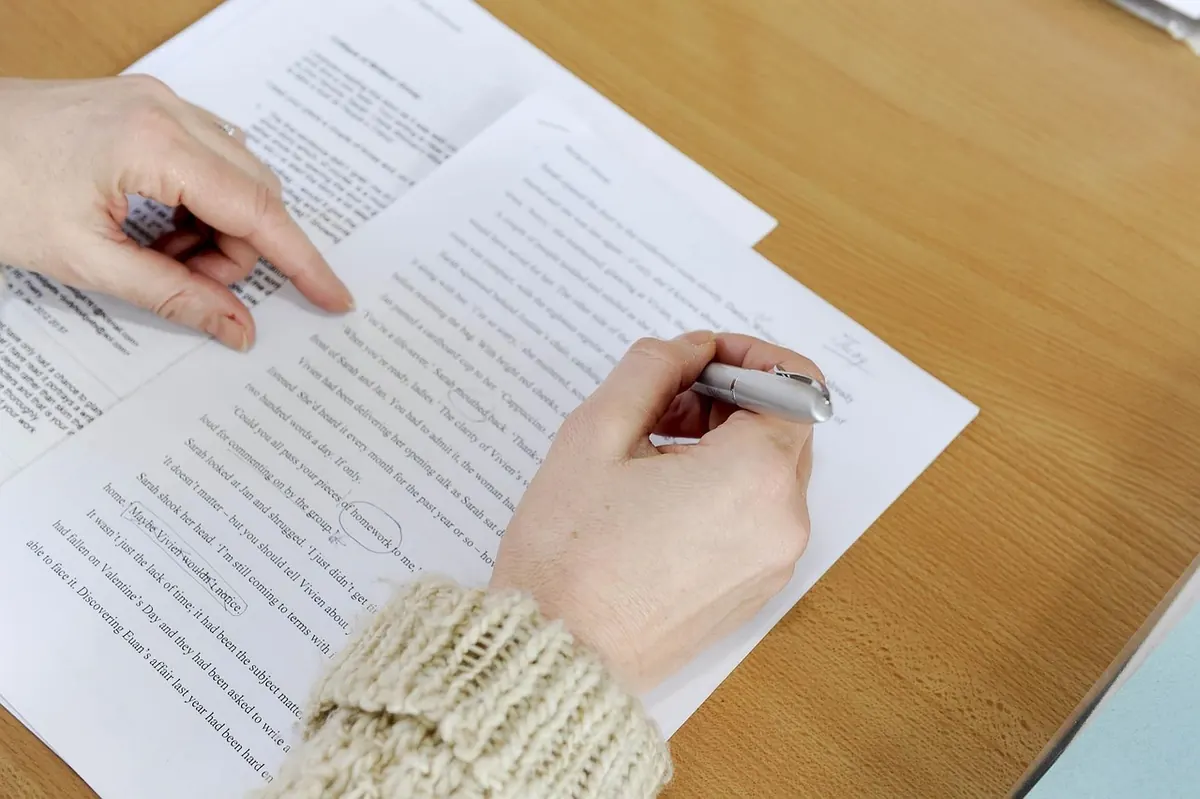
This pass is mechanical, and that is the point. Change the format so your brain stops skimming: a different font, a printed copy, a tablet instead of a laptop. Read aloud. Your ear catches what your eye forgives — a missing word, a sentence that runs out of breath, a line of dialogue that no human being would say.
Check the boring consistencies: character names and spellings, place names, the colour of a car in chapter three, chapter numbering, dates. Look at punctuation as a system — whether you use the serial comma, how you set ellipses and dashes, whether thoughts are italicised. Pick a style and keep it.
Do not fix story problems here. If you spot one, write it on a list and keep going. Proofreading and rewriting pull in opposite directions, and doing both at once means doing neither well.
Space the passes out. A week between pass one and pass two will give you the distance to see your own book rather than the one you meant to write. Do one pass per session, and if you catch yourself rewriting a paragraph during pass one, stop and make a note instead.
Between passes two and four, it helps to hand the manuscript to a trusted reader and ask specific questions: where did you get bored, where were you confused, which character did you want more of? Vague praise is pleasant and useless; specific complaint is a gift.
Finally, know when to stop. Two careful proofreads are worth more than ten anxious ones, and every pass after that yields diminishing returns. When the changes you are making are as likely to make the book worse as better, put the pen down, send it out, and start something new.
Photo: MART PRODUCTION / Pexels
A month-by-month guide to when UK literary agents are busiest, how long replies take, and how to plan your...
A practical UK-focused comparison of traditional and self-publishing, covering costs, timelines, rights...
A practical British English copyediting checklist for fiction: UK spelling, punctuation, dialogue...