Submitting to UK Literary Agents: A Seasonal Timeline for Debut Novelists
A month-by-month guide to when UK literary agents are busiest, how long replies take, and how to plan your...

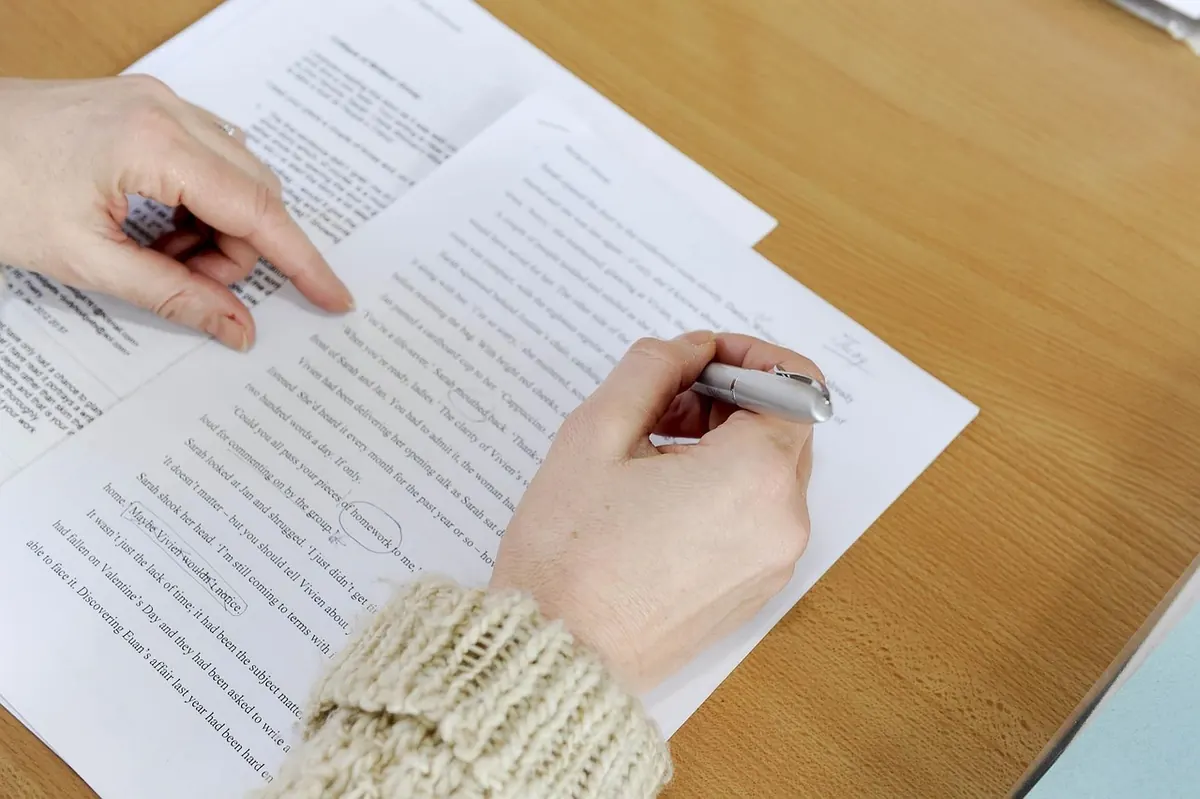
Your draft is finished. The plot holds, the characters sound like themselves, and somewhere in chapter nine there's a sentence you're quietly proud of. Now comes the pass readers never notice when it's done well and always notice when it isn't: copyediting.
British English fiction has its own set of conventions, and they trip up experienced writers as often as beginners. What follows is the checklist to work through before a manuscript goes to a competition, an agent, or a proofreader.
British spelling isn't one thing. Oxford leans towards -ize; most UK publishers use -ise. Neither is wrong, but mixing them in one manuscript is. Pick a dictionary — Collins, Chambers or Oxford — and treat it as the final word.
Here's a quick diagnostic. Run a search for -ize, -ization and -yze. If chapter three has realise and chapter twelve has organize, you've just found the kind of drift an editor spots in the first ten pages, and it tells them nobody read the manuscript as a whole.
Then watch for the pairs that always slip through:
Leave proper nouns alone. A character from Boston doesn't live in a colourful neighbourhood unless the narrator is British, and you shouldn't Britishise brand names, song titles or signage.
Punctuation is where British fiction differs most from American fiction, and where inconsistencies show up fastest.
Single quotation marks are the usual convention in British fiction: 'Don't wait up.' Some UK publishers use double, and both are defensible. What isn't defensible is changing your mind halfway through. Nested speech is the reverse: single outside, double inside — 'He told me, "Don't wait up."'
Punctuation that belongs to the spoken line stays inside the closing mark. Punctuation that belongs to the surrounding sentence sits outside.
'I'm not staying,' she said.
Now compare that with He called her 'the boss', then laughed. Here the comma belongs to the whole sentence, not to the quoted words, so it sits outside. That second pattern is the one writers get wrong most often.
British books generally use spaced en dashes – like this – for parenthetical asides and interruptions, while American style prefers closed-up em dashes—like this. Choose one and never use a hyphen as a substitute. For ellipses, three dots is standard; decide whether you'll space them and keep it identical throughout. Four dots should be rare, and only when a full stop and an ellipsis genuinely collide.
British style usually omits the comma before and in a list. Add it when it prevents ambiguity: She thanked her parents, the doctor and the nurse. Fine. She thanked her parents, the doctor, and the nurse. Also fine, if that's the reading you want.
Then drop the full stops from abbreviations: Mr, Mrs, Ms, Dr, St, UK, USA, BBC, NHS, MP. The old rule still holds — contractions that end on the last letter of the word take no stop, while truncations that cut a word short keep one: etc., ed., vol., p. For eg and ie, modern British practice is no stops and no following comma. And keep initials plain: J K Rowling, not J. K. Rowling, unless a character is writing a formal letter in 1953.
British fiction usually spells out numbers up to ten — some house styles go to one hundred — and uses numerals above that. Dialogue is the exception: if a character would say it aloud, write it aloud.
None of these decisions matters as much as holding them for ninety thousand words. An editor will forgive 1990s; they won't forgive 1990s on page four and 1990's on page ninety.
Copyediting British dialogue is a tug-of-war between accuracy and readability. You want the reader to hear the accent; you don't want them decoding it.
A Yorkshire character who says t'pub on every page becomes a novelty act by chapter four. A Scottish character rendered entirely in phonetics reads as a transcription, not a person. Let syntax, rhythm and word choice do most of the work — I'll not be long tells the reader more than any dropped g — and drop in a light phonetic touch only when it earns its place.
Three practical rules:
The single most useful tool in a British copyedit is a one-page style sheet: a list of every decision you've made, so that decision survives to page four hundred.
It doesn't need to be elaborate. A few lines will do:
Every entry turns a judgement call into a search-and-check. When you reach the final pass, you're no longer deciding; you're verifying. That's the difference between a copyedit that takes a weekend and one that takes a month.
Last of all, read the dialogue aloud. Your ear catches what your eye skips: the comma that turns a statement into a stumble, the sentence that runs out of breath, the said-bookism you would never say out loud.
While you're there, run a handful of searches that catch mechanical damage: double spaces, straight quotes left over from a draft, well known beside well-known, alright beside all right, and the words you lean on — just, suddenly, a little. None of them is wrong. All of them, repeated two hundred times, become your voice without your permission.
Then put the manuscript down for a week and read the first chapter again. Distance is a copyediting tool as reliable as any dictionary: it's the only way to see the page the way a competition judge, an agent or a stranger in a bookshop will see it.
None of this is glamorous work, and nobody will ever thank you for it. But a manuscript that arrives clean says something before the first line is read: that the writer reads closely, and that the book has been finished, not merely stopped.
Photo: WokinghamLibraries / Pixabay
A month-by-month guide to when UK literary agents are busiest, how long replies take, and how to plan your...
A practical UK-focused comparison of traditional and self-publishing, covering costs, timelines, rights...
Self-editing a novel is easier when you stop trying to fix everything at once. This five-pass method moves...