Submitting to UK Literary Agents: A Seasonal Timeline for Debut Novelists
A month-by-month guide to when UK literary agents are busiest, how long replies take, and how to plan your...


Act two is where most drafts go soft. The opening has momentum because everything is new. The ending has shape because you have known since page one roughly how it finishes. In between, you have a lot of pages and no obvious job for them.
A sagging middle is rarely one big mistake. It is usually a handful of small ones, each shaving a little tension off the story until the reader can put the book down without regret and pick it up again next week. Here are the seven that come up most often, and what to do about each.
If your character wants to be happy, to belong, or to find themselves, you have a theme, not a goal. Themes are what the story is about. Goals are what the character does on Tuesday.
Give them a want that can be measured and missed. Not “to reconnect with her sister” but “to get her sister to sign the house over before the auction on Friday”. Now every scene can be scored: did she move closer, or further away? If you cannot answer that at the end of a chapter, the chapter is probably filler.
The test: write the goal in one sentence with a deadline in it. If you cannot, your middle has nothing to push against.
Passive protagonists get dragged through the middle by coincidence, bad weather and other people’s plans. Readers notice, even when they cannot name what is wrong, and they start to sense the story would run fine without your main character in it.
Look at your last five scenes. Who made a decision that caused the next scene? If the answer is the antagonist, a mentor or an accident, rewrite a couple so the protagonist chooses — and chooses badly, if you want momentum. A wrong decision that has to be unpicked is worth three chapters of brooding.
Midpoints fail in two directions. Either nothing happens and the characters consolidate, or something big happens that should change everything and somehow doesn’t.
A working midpoint does one of two jobs. It reveals information that reframes what came before, or it reverses the protagonist’s fortunes and closes off the easy route. If your detective learns at the midpoint that the victim was still alive at midnight, the second half can no longer be about proving the alibi. It has to be about something new.
Ask what your protagonist can no longer do after the midpoint. If the answer is “not much”, you have found the sag.
Explosions are easy to write and easy to ignore. Escalation works when it presses on something the character cannot walk away from.
Pick two and run them through the middle. A story where the protagonist loses something irreplaceable in each act will hold attention far better than one where the stakes simply get louder.
If a subplot can be lifted out without leaving a hole, it is not doing its job. B-plots earn their pages by interfering. They steal time from the main goal, tempt the protagonist off course, or supply the resource that is needed later. They also give the reader somewhere to rest without going slack.
Practical version: for each subplot, finish this sentence — “Because of this subplot, the main plot…” If you cannot complete it in a way that matters, cut the subplot or fold its best scene into the main line.
Read the closing line of ten scenes in a row. If they all land on a note of unease, or all on a small victory, the middle will feel longer than it is. Rhythm matters as much as content.
This is not an argument for cliffhangers at the end of every chapter; that gets numbing quickly. It is about turning. A scene can finish on a decision, a revelation, a refusal, a fresh complication, a moment of false safety or a genuine loss. Mix them, and the reader stops being able to guess whether the next scene will cost or pay.
Villains are often vivid in act one and then vanish for two hundred pages while the protagonist has feelings. In their absence, the middle loses its engine. Someone should be working against the goal, on the page or just out of sight.
Keep the antagonist active even when they are offstage: show the consequences of their decisions, or let them win something small and unseen. If you have no antagonist, something else has to apply the pressure — a rival, an institution, a deadline, the protagonist’s own body or reputation. Whatever it is, it should be doing something in nearly every chapter.
When you know something is wrong but not what, run this over your draft in one sitting.
Fix the zeros first. Cutting a scene costs less than rewriting three, and it often solves the pacing on its own. If a scene cannot be given a job, do not agonise over it — cut it and see what breaks.
Expect the middle to wobble again in the next draft. It does for almost everyone. The point is not to write a second act that never dips, but to know where to press when it does. Your middle does not need to be relentless. It needs to keep costing your protagonist something, and to keep the reader unsure whether they will get what they want. Do that, and the pages will turn themselves.
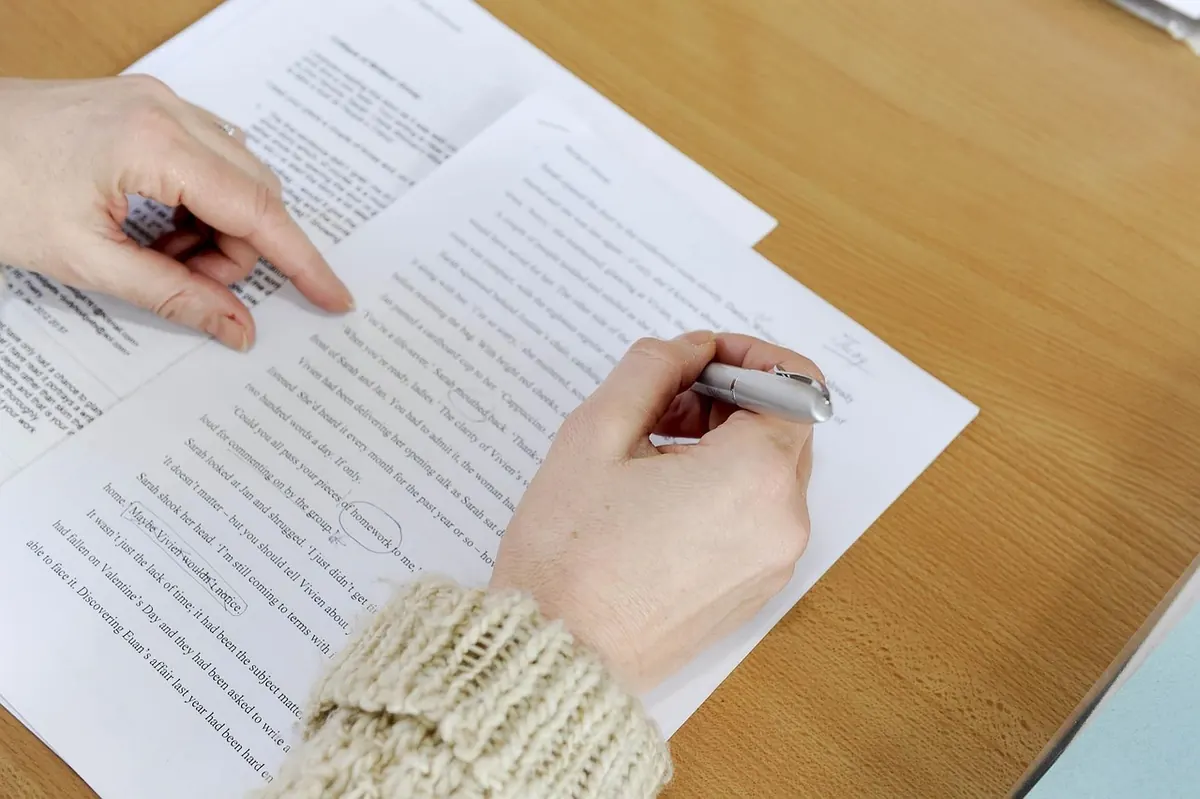
Photo: Julia Volk / Pexels
A month-by-month guide to when UK literary agents are busiest, how long replies take, and how to plan your...
A practical UK-focused comparison of traditional and self-publishing, covering costs, timelines, rights...
A practical British English copyediting checklist for fiction: UK spelling, punctuation, dialogue...